
Politicians trade stocks, so do corporate executives. Both groups consistently beat the market, sometimes making tens of millions on single "well timed" trades.
What surprises most investors is that this is 100% legal if they file the proper paperwork on time.
Insiders can buy and sell, but they have to report their trades to the SEC and they typically go public within a few days of the trade.
In 2024, I started reading these reports and copying insiders. In 2025 I built an AI that reads thousands of these reports for me, finds patterns and separates signals from noise.
Here's how you can do it too.
TLDR
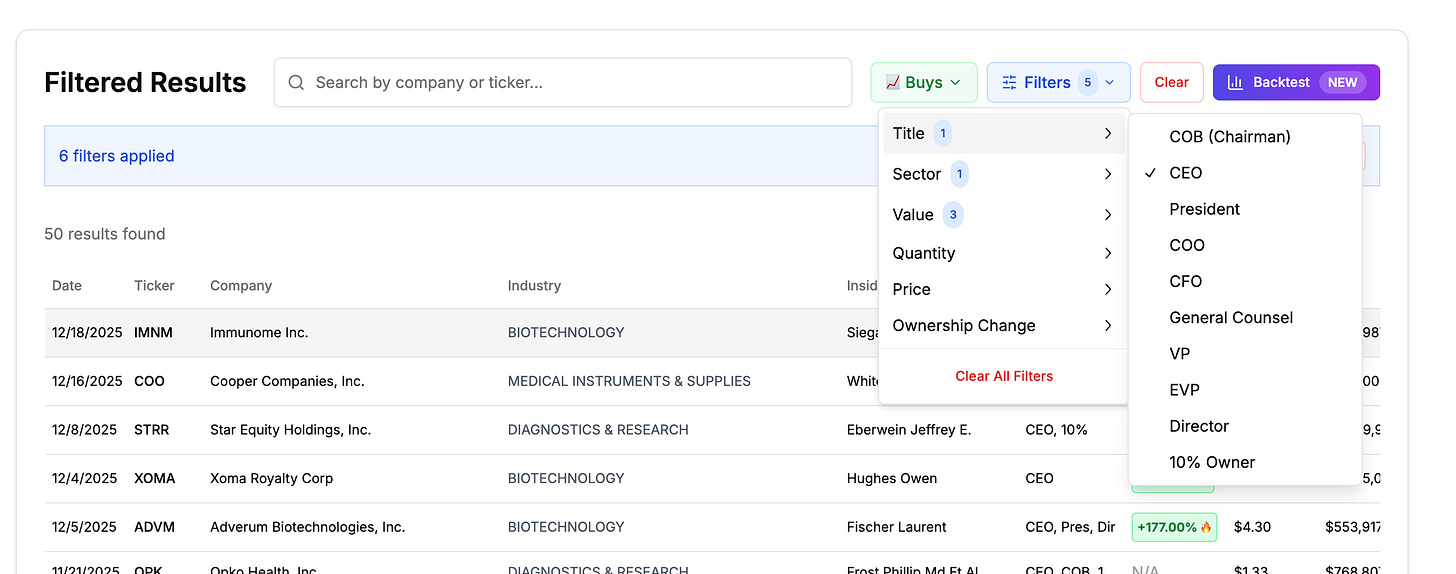
- Go on insidersignal.ai and sign up (it's free)
- Set the trade filter for insider buys over $500k by CEOs
- Filter sectors by healthcare companies to view recent significant stock purchases by healthcare CEOs
- Pay special attention to the most recent trades (you have the highest opportunity when buying within a few minutes of the filing going live)
- The bigger the buy, the more you can invest
- Set a stop loss and manage your risk
- Do your own research, this is not financial advice
Personally, I bought as soon as filings went public and sold when it grew 5% or 30 days had gone by with a 5% stop-loss. My original goal was to build an AI stock insight SAAS, but so far I've made 12x more money actually copying insider trades vs. subscriptions.
Do whatever you want with this information. If you want to know my whole process, read on.
Corporate Insiders vs. Politicians
Nancy Pelosi's stock portfolio has become a meme for a reason. Her returns outpace most professional fund managers. Congressional trades, disclosed months after execution, still show abnormal performance. The information advantage is real.
Corporate insiders play the same game with better rules. When a CEO buys stock in their own company, they must file a Form 4 with the SEC within 2 days.
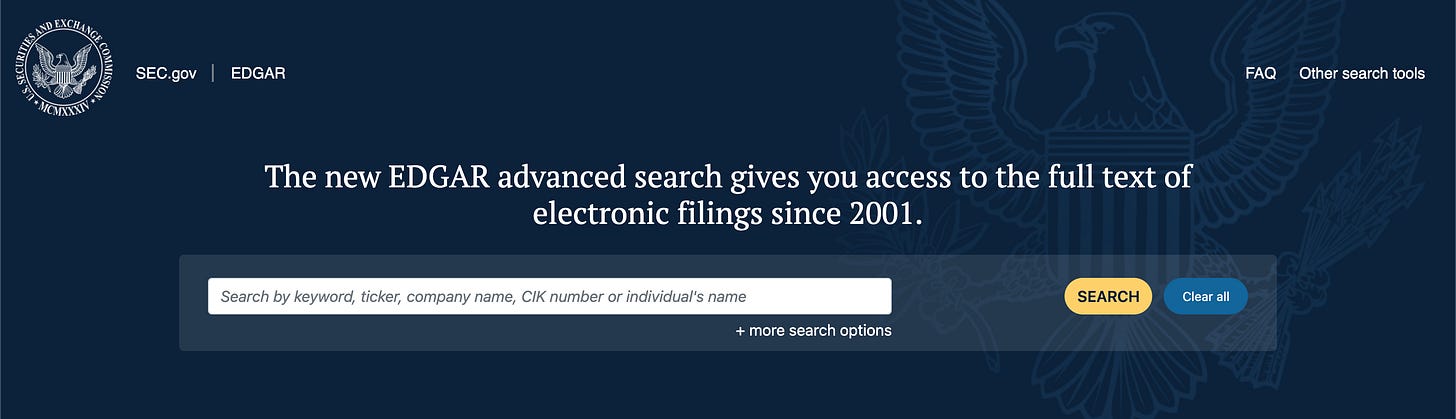
Form 4's contain exact info on what they bought or sold, at what price and how much. Then that filing goes public immediately and can be viewed on sec.gov/edgar.
These forms aren't exactly light reading and there are thousands of new filings every day. That's why I created insidersignal.ai to monitor them 24/7 and send me the best trades.
People on the inside will always have an edge in the market.
Follow the right insiders, in the right sectors, with the right exit strategy, and you capture some of that edge.
But these strategies can be volatile. A single trade might swing 20% in either direction. You have to think about Sharpe ratios and measure risk-adjusted returns. They separate skill from luck. That's the metric I optimized for.
I tested 26,808 combinations across every permutation of insider type, sector, exit strategy, and position sizing. Then I validated on out-of-sample data.
Certain combinations produce Sharpe ratios above 5.0. The average hedge fund sits around 0.5. These strategies beat 93% of professional money managers on a risk-adjusted basis.
I've traded these strategies throughout 2025 with my own capital. The alpha is real.
This article covers what works, what doesn't, and the specific filters I use. Everything is based on public SEC filings. Everything is legal.
The Insider Price Gap
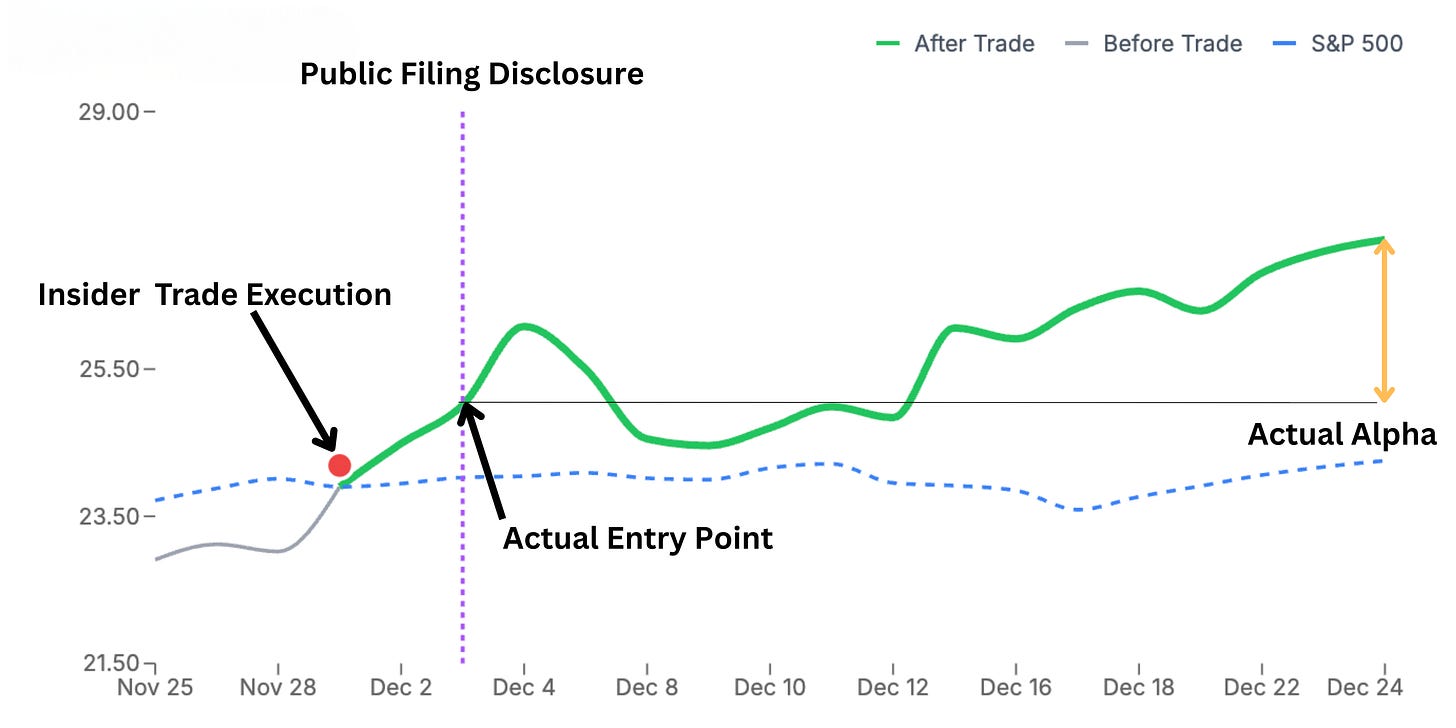
When an insider buys stock, they pay the market price on that day. You don't see the Form 4 until up to two business days later. The stock may have moved.
Your entry point is the price on the day you learn about the trade. The insider's return and your return are different numbers.
My backtesting accounts for this. Every simulated trade enters at the closing price on the filing date. This reflects what you'd actually experience copying the trade.
Enough edge survives the disclosure delay to make copying profitable. But only for specific trade types.
(For a deeper primer on how insider filings work, see my Insider Trading 101 guide.)
Why Most Insider Trade Copiers Fail
Most retail investors see a headline about a CEO buying $2 million in stock. They buy the next morning. They hold indefinitely.
This approach fails for three reasons.
First, a 10% owner buying shares might be averaging into a position for tax reasons. A CEO buying shares probably knows something about next quarter's earnings. Same Form 4 filing. Completely different signal quality.
Second, a healthcare CEO buying before an FDA decision is trading on visibility into a binary event. A retail CEO buying before holiday sales is guessing about consumer sentiment. One signal works. One doesn't.
Third, the insider's informational edge decays. Hold too long and you're riding market beta. The optimal holding period is days, not months.
I tested all of this systematically. Some approaches generate consistent alpha. Others are noise. A few destroy value.
The Strategies That Actually Work
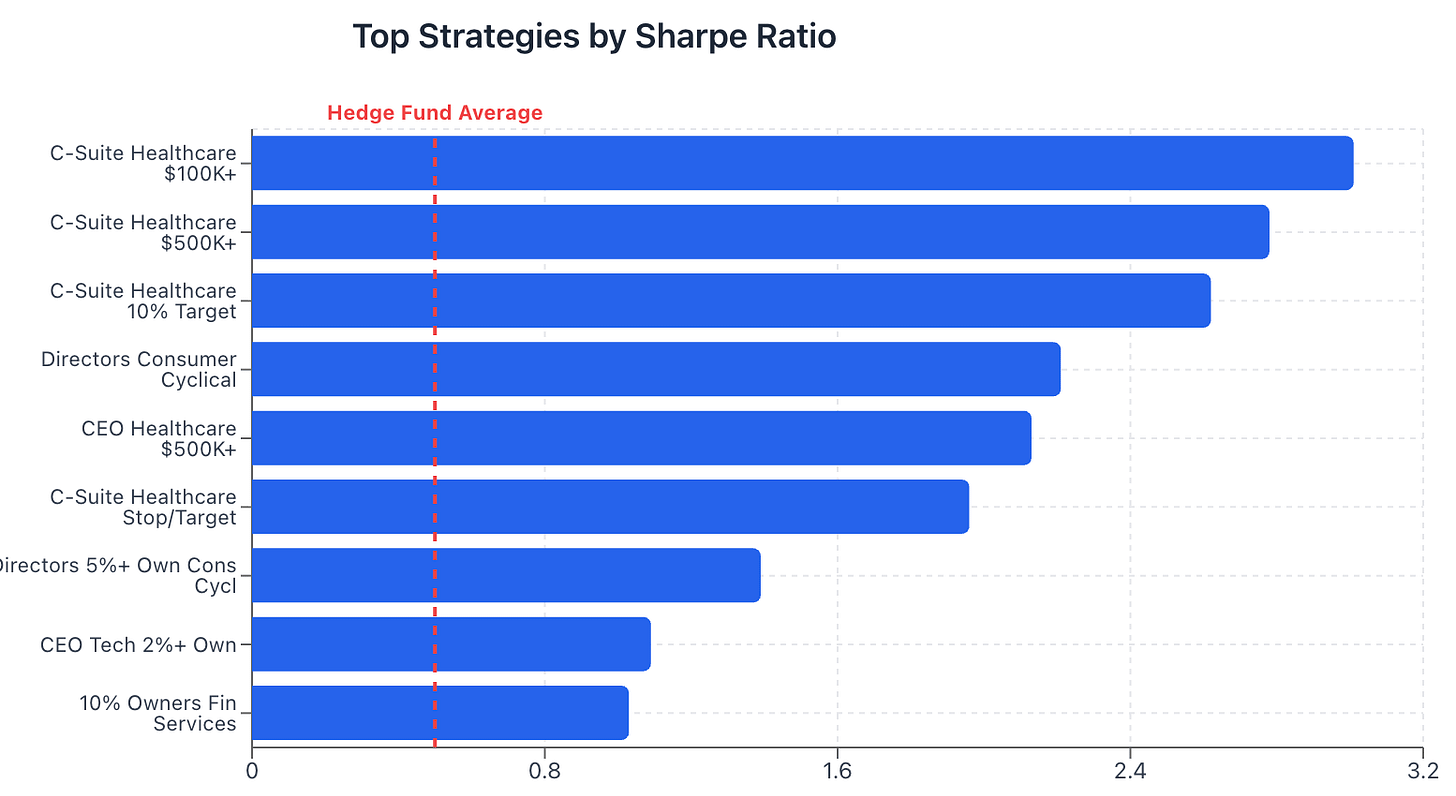
The single best combination: C-Suite executives buying in Healthcare, trades above $100K, exiting at a 5% gain or 30 days, weighted by trade value. Out-of-sample Sharpe ratio of 3.01.
The average hedge fund Sharpe ratio hovers around 0.5. A Sharpe above 1.0 is excellent. Above 2.0 is exceptional. I found multiple combinations above 2.0 that held up in out-of-sample validation.
Top performers from my backtests (validated on recent trades):
| Strategy | Validated Sharpe | Avg Alpha / Trade |
|---|---|---|
| C-Suite, Healthcare, $100K+, by value | 3.01 | 4.4% |
| Director, Consumer Cyclical, by value | 2.21 | 4.4% |
| CEO-only, Healthcare | 2.13 | N/A |
| CEO, Technology, 2%+ ownership change | 1.09 | 3.7% |
| 10% Owner, Financial Services, $1M+ | 1.03 | N/A |
All of these held up in out-of-sample validation. The signal persisted in recent trades.
Common thread: short holding periods, specific sector focus, filtering by insider type. Generic "follow all insider buys" strategies don't make this list.
C-Suite Healthcare Dominates
I tested multiple categories of insiders across different sectors.
C-Suite executives buying Healthcare stocks produced a validated Sharpe of 3.01. Directors in Consumer Cyclical came in at 2.21. CEO-only Healthcare trades produced 2.13. 10% owners in Financial Services generated 1.03.
C-Suite Healthcare trades outperformed 10% owner trades by 3x on a risk-adjusted basis.
A healthcare CEO knows the FDA meeting outcome. They know the clinical trial data before the press release. They know if the drug works. When they buy, they're betting on information they have direct access to.
A 10% owner is often a fund or institution. They buy for portfolio construction. Tax loss harvesting. Rebalancing. Liquidity events. Their Form 4 looks identical to a CEO's. The information content is completely different.
First filter: focus on C-Suite executives. Ignore 10% owners unless they're in Financial Services with $1M+ trades.
Sector Selection Changes Everything
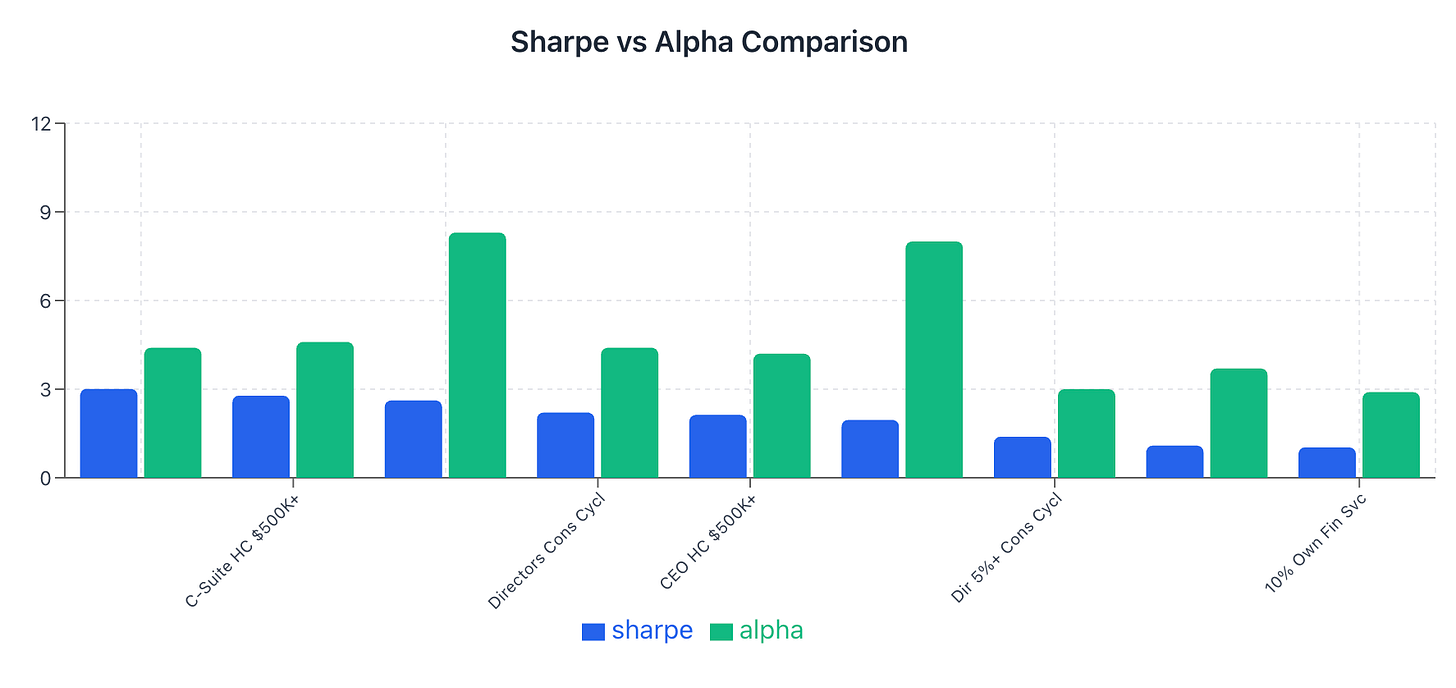
Healthcare C-Suite trades produced a validated Sharpe of 3.01 with 4.4% alpha per trade. Consumer Cyclical Director trades came in at 2.21 with 4.4% alpha. Technology CEO trades showed 1.09 Sharpe with 3.7% alpha.
Healthcare CEOs trade around FDA decisions, clinical trial readouts, and pipeline developments. Binary events with asymmetric information. The CEO knows the probability of approval better than the market.
Directors in Consumer Cyclical showed surprisingly strong results. These board members see retail trends, inventory levels, and consumer sentiment before earnings reports. When they buy heavily, pay attention.
Technology CEOs see the sales pipeline and bookings data before it hits the earnings report. When sentiment turns negative but fundamentals remain strong, they buy. The 2%+ ownership change filter helps isolate conviction buys.
Second filter: Healthcare for C-Suite. Consumer Cyclical for Directors. Technology for CEOs with meaningful ownership increases.
Exit Fast
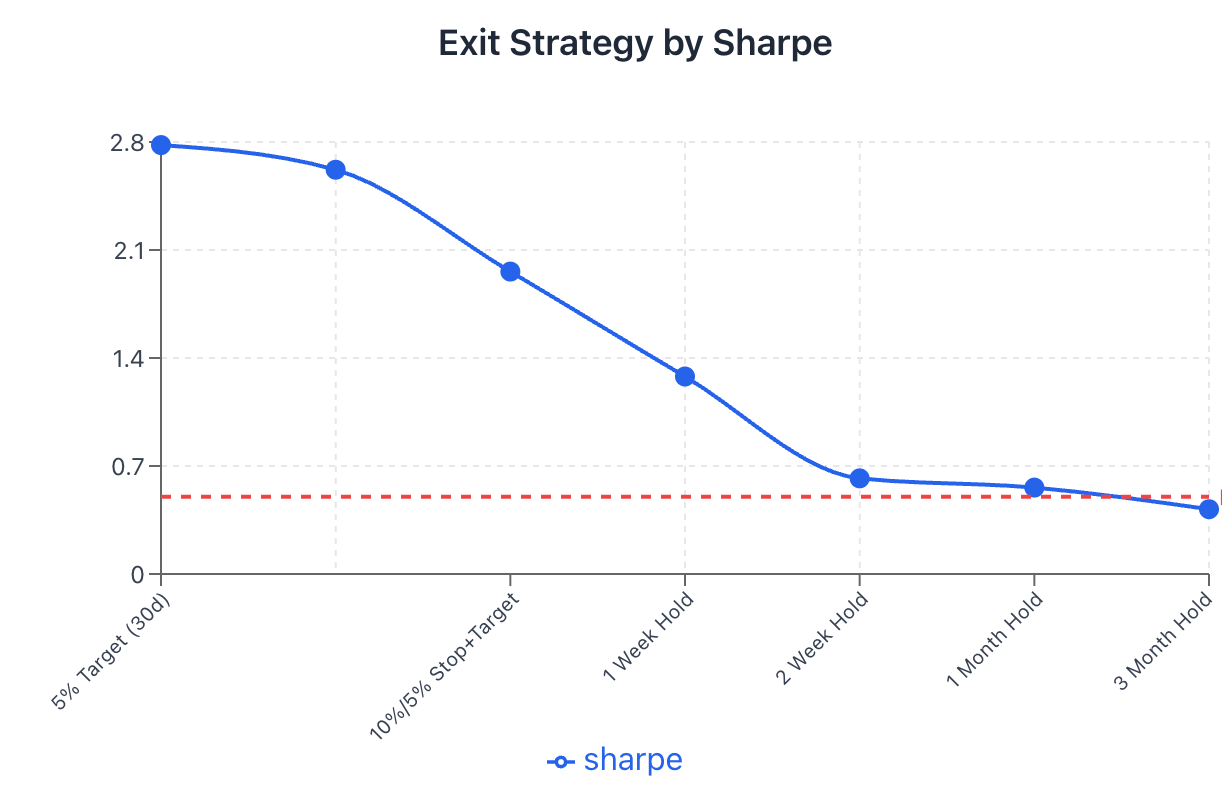
I tested eight exit strategies ranging from one week to three months.
A 5% target exit with a 30-day maximum hold produced a validated Sharpe of 2.78 for the top strategy. A 3-month fixed hold degraded to 0.42. The short-term strategy outperformed by 6x.
Average holding period for winning trades: 2.6 to 4.4 days.
| Exit Strategy | Sharpe | Avg Days Held |
|---|---|---|
| 5% Target (30d max) | 2.78 | 4.4 |
| 10% Target (60d max) | 2.62 | 5.8 |
| 10%/5% Target + Stop | 1.96 | 4.9 |
| 1 Week Hold | 1.28 | 5.0 |
| 2 Week Hold | 0.62 | 10.0 |
| 1 Month Hold | 0.56 | 21.0 |
| 3 Month Hold | 0.42 | 63.0 |
Markets are efficient enough to incorporate public information eventually. The Form 4 gets filed. Analysts notice. The stock moves. By week two or three, the edge has been arbitraged away.
Holding past that point adds market risk without adding alpha.
Set a 5% profit target. If the stock hits it, take the money. If it doesn't hit within 30 days, exit anyway.
Out-of-Sample Validation
I split the trades chronologically. Older 70% for training. Recent 30% for testing.
The C-Suite Healthcare $100K+ strategy actually improved on test data. A rare and strong validation signal.
Other strategies showed expected decay from training to test, but all remained profitable with Sharpe ratios above 1.0. No strategy collapsed. No overfitting detected.
100% of top strategies maintained positive alpha in the test period. All maintained Sharpe ratios above hedge fund averages.
What Didn't Work
Weighting by ownership change underperformed weighting by dollar value in most cases. The by_own_change weighting produced lower Sharpe ratios than by_value for Healthcare and Consumer Cyclical strategies.
Long holding periods destroyed returns. The 3-month hold strategies showed Sharpe decay of 80%+ compared to the 5% target exit.
10% owners in most sectors provided minimal edge. Exception: Financial Services $1M+ trades, which still produced a 1.03 Sharpe.
Single insider trades carry the full signal. Waiting for cluster confirmation reduces sample size without improving risk-adjusted returns.
My Playbook for 2026
After 26,000+ combinations tested and validated:
Filter by insider type and sector together. C-Suite executives in Healthcare. Directors in Consumer Cyclical. CEOs in Technology with 2%+ ownership increases. The combination matters more than either factor alone.
Filter by trade size. 500K for CEO-only strategies. $1M for 10% owners.
Exit fast. 5% profit target with 30-day maximum hold. Average holding period under 5 days. The signal decays rapidly.
Weight by conviction. Size positions by the insider's dollar commitment. Larger trades carry more signal. by_value weighting outperforms equal weighting.
Trust the validation. Every strategy listed here held up in out-of-sample testing on recent trades. Training Sharpe doesn't matter. Test Sharpe does.
These filters produce validated Sharpe ratios that outperform 90%+ of hedge funds.
The Form 4 filings are public. The SEC mandates disclosure within two business days. Everything here is legal. The edge comes from reading the filings more carefully than everyone else.
All trades discussed are publicly disclosed via SEC Form 4 filings, available through the SEC's EDGAR database and aggregated on insidersignal.ai. This analysis is for informational purposes only and does not constitute investment advice.